


Support Center
Support Center
Technischer Support
Wir unterstützen Sie bei Fragen zu unseren Produkten und Lösungen. Unser technisches Support-Team hilft Ihnen schnell und kompetent bei allen Fragen rund um esave Produkte, Systeme und Anwendungen.
Wir unterstützen Sie bei:
- Technischen Fragen zu Produkten und Systemen
- Installation und Inbetriebnahme
- Konfigurationen
- Fehleranalyse und Systemoptimierung
E-Mail Support:
support@esaveag.com
Telefonischer Support:
+41 81 511 55 52
Erreichbarkeit:
Montag – Freitag
09:00 Uhr – 12:00 Uhr
13:00 Uhr – 18:00 Uhr
Antwortzeit per E-Mail:
In der Regel innerhalb von zwei Stunden während unserer Geschäftszeiten.
esave system training
Die esave Systemschulung vermittelt Kunden und Partnern das notwendige Wissen, um unsere intelligenten Beleuchtungssysteme sicher zu installieren, zu konfigurieren und effizient zu nutzen. Die praxisorientierte Schulung kombiniert theoretische Grundlagen mit praktischen Anwendungen und bereitet Sie optimal auf den Einsatz der esave Lösungen vor.
Nach Abschluss der Schulung können die Teilnehmenden grundlegende Installationen und Konfigurationen mit SL-Configurator und SL-Control selbstständig durchführen.
Inhalte der Schulung:
- Überblick über die esave Lösungen
- Installation und Inbetriebnahme
- SL-Configurator und SL-Control
- Konfiguration und Funktionen
- Produktneuheiten und Updates
- Praxisbeispiele und Best Practices
Did you know?
The cloud-based control system offers centralized management and monitoring of the lighting system via the Internet. All luminaires and controls can be monitored in real time and adjusted as needed. This solution enables efficient remote maintenance, fault diagnosis, and analysis of measurement results to continuously optimize lighting. The SL Control interface provides an API interface for flexible integration of special requirements.
The stand-alone control system allows esave lights to be managed and configured via a mesh network without the need for an internet connection. Users can make adjustments directly on site and configure the system according to specific requirements. Once set up, the lighting operates autonomously and independently of external networks.
Advantages of cloud-based solutions:
- Centralized management and monitoring via the Internet, accessible anytime, anywhere
- Efficient maintenance planning
- Comprehensive analysis functions for continuous optimization
- Flexibility through API interfaces for the integration of specific requirements
Advantages of stand-alone:
- One-time acquisition costs without recurring license fees
- Autonomous system – configurations and updates can be performed on site
- Local data storage – no internet connection required
- Autonomous system – on-site adjustments
Technical requirements for cloud-based and stand-alone lighting control:
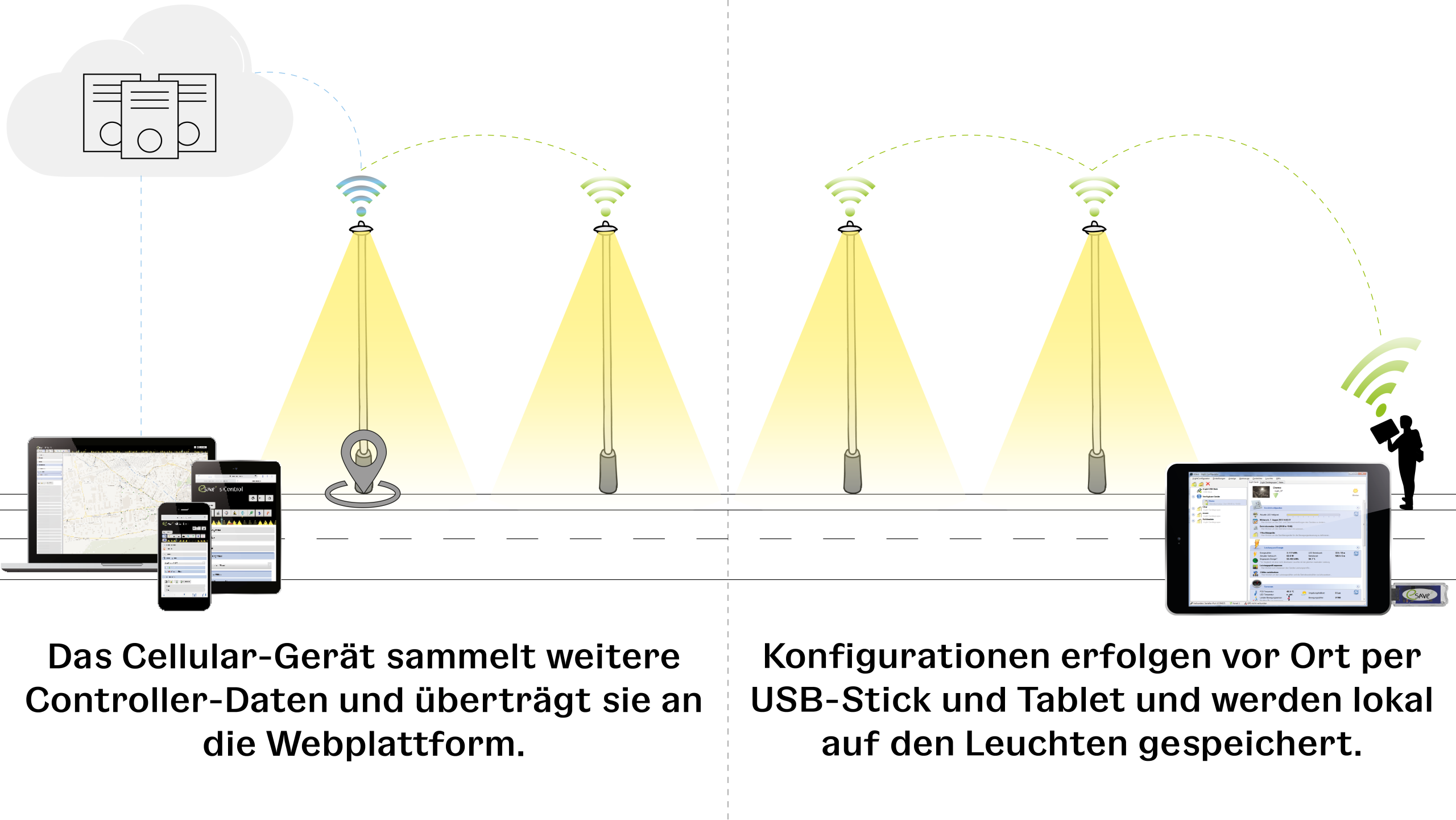
Cloud-based control: A cellular device acts as a gateway and connects up to 100 controllers to the SL-Control platform.
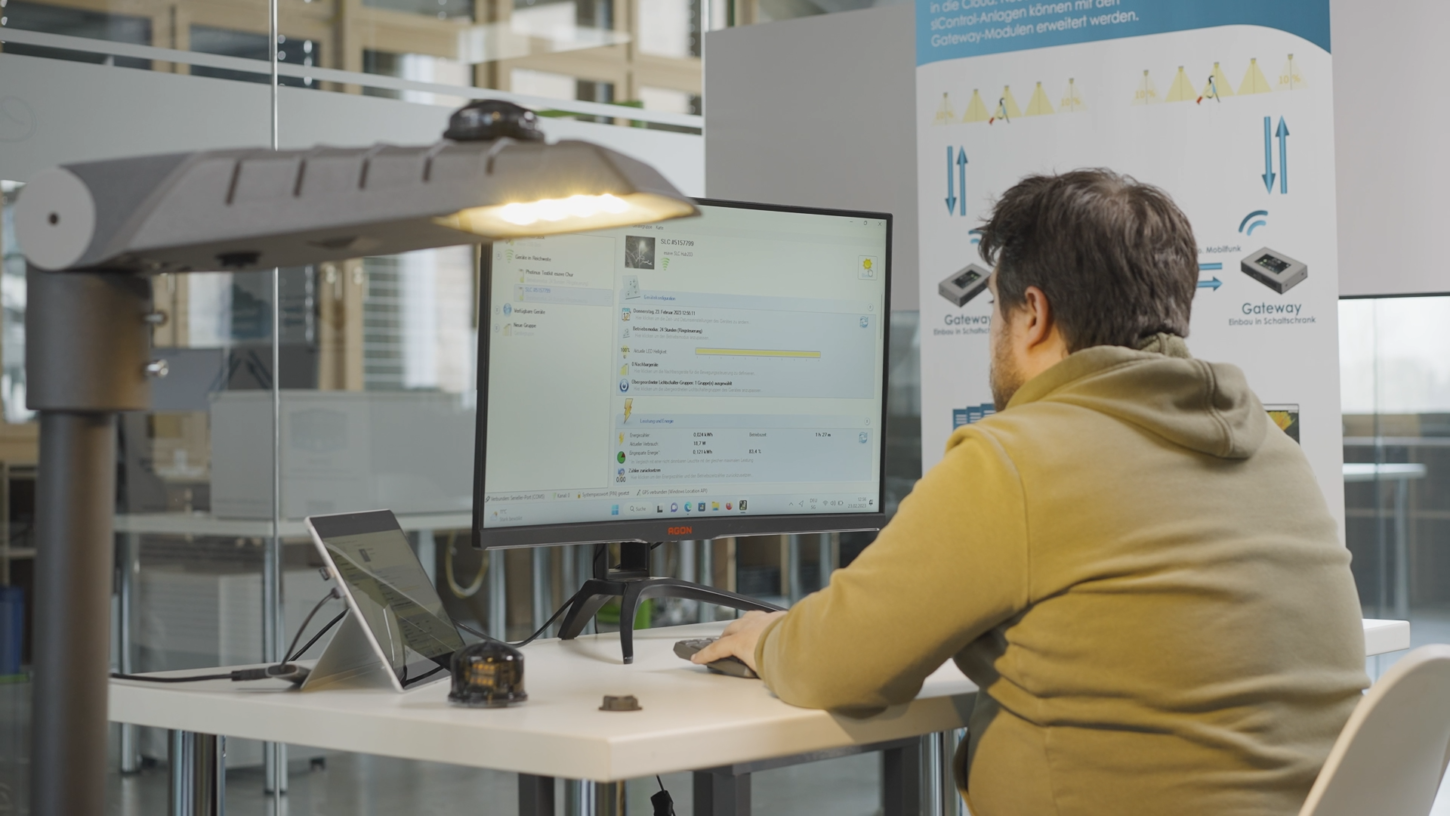
Stand-alone control: Requires an SL-Configurator USB stick and a tablet or laptop with the software installed. The connection is established via a local mesh network – without the internet.
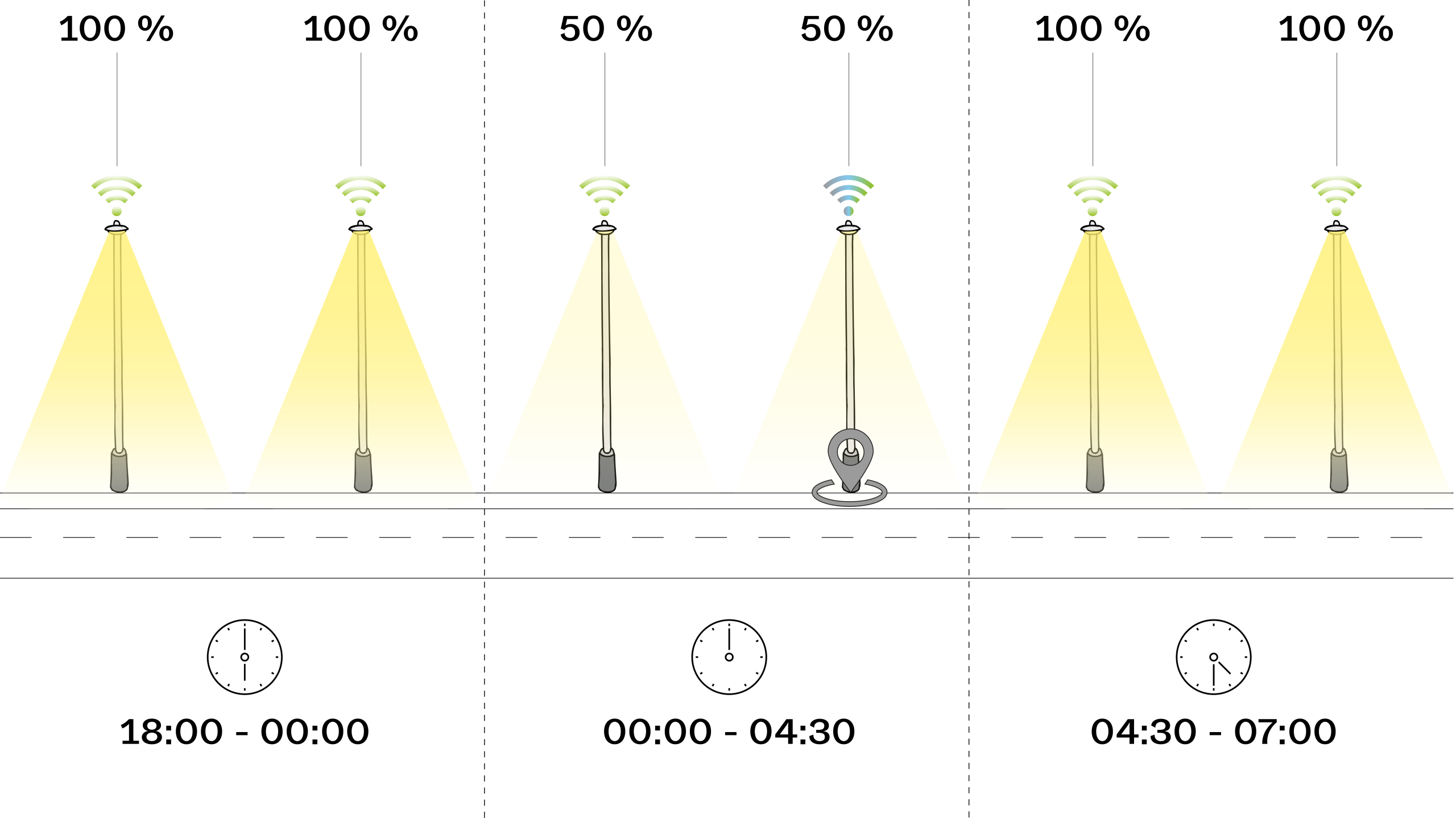
With time-based lighting control, the brightness of street lighting is regulated according to defined times. This type of control follows a defined schedule that can be individually adapted to the needs of each location.
Different dimming profiles can be stored for each day of the week. For example, a different sequence can be set for the weekend than for weekdays.
Monday–Friday:
- 6:00 p.m.–12:00 a.m. → 100% brightness
- 12:00 a.m.–4:30 a.m. → Reduction to 50%
- 4:30–7:00 a.m. → 100% brightness
Saturday – Sunday:
- 6:00 p.m.–2:00 a.m. → 100% brightness
- 2:00 a.m.–4:30 a.m. → Reduction to 50%
- 4:30–7:00 a.m. → 100% brightness
Technical requirements for time-based control:
In principle, any esave controller can be used for time-based control. However, it is important that at least one controller in the mesh network is equipped with a cellular function.
This special controller has an integrated GNSS (Global Navigation Satellite System) receiver that serves as the central time source. It automatically transmits the current time information to all other controllers in the network.
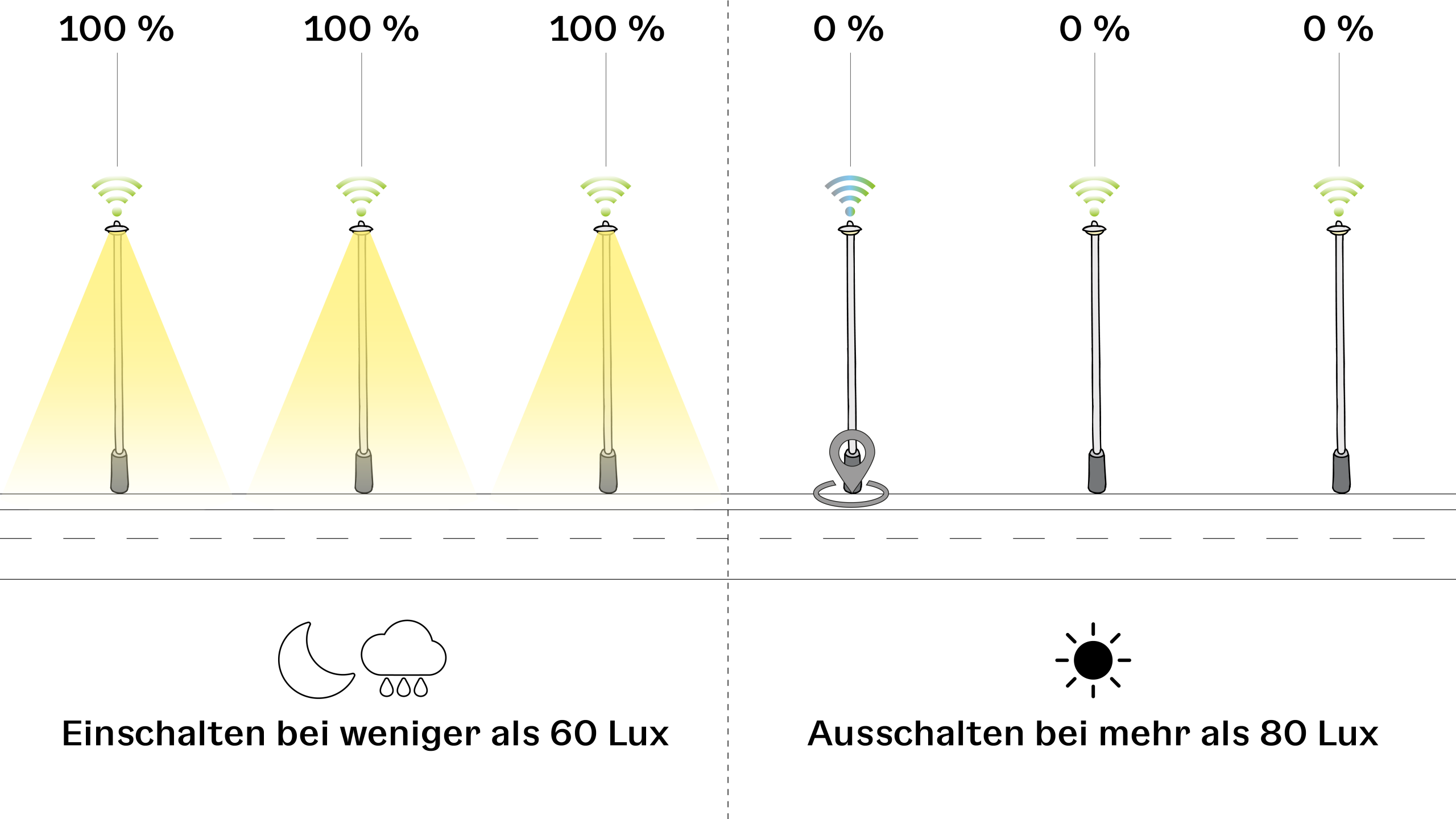
With brightness-based control, street lighting is switched on and off depending on the actual ambient light. All Zhaga controllers are equipped with a brightness sensor. This continuously measures the current lux value on site.
As soon as the light falls below a defined threshold value – for example, at dusk or due to poor weather conditions such as fog or rain – the lights switch on automatically. When the specified brightness value is exceeded again, for example at sunrise or when visibility is clear, the lights switch off again.
This form of control is particularly demand-oriented, as it reacts directly to the lighting conditions at the location – without any fixed time specifications.
- Schaltschwelle zum Einschalten: z.B. < 60 Lux
- Switch-off threshold: e.g., > 80 lux
Control is based on predefined lux thresholds that can be individually adjusted to the location. The lighting remains active between these two thresholds. The tolerance range between the switch-on and switch-off values prevents too frequent switching when lighting conditions change.
Our Zhaga-based controllers feature an integrated brightness sensor. A single master sensor in the mesh network is sufficient to relay the on/off command to all other controllers based on lux values.
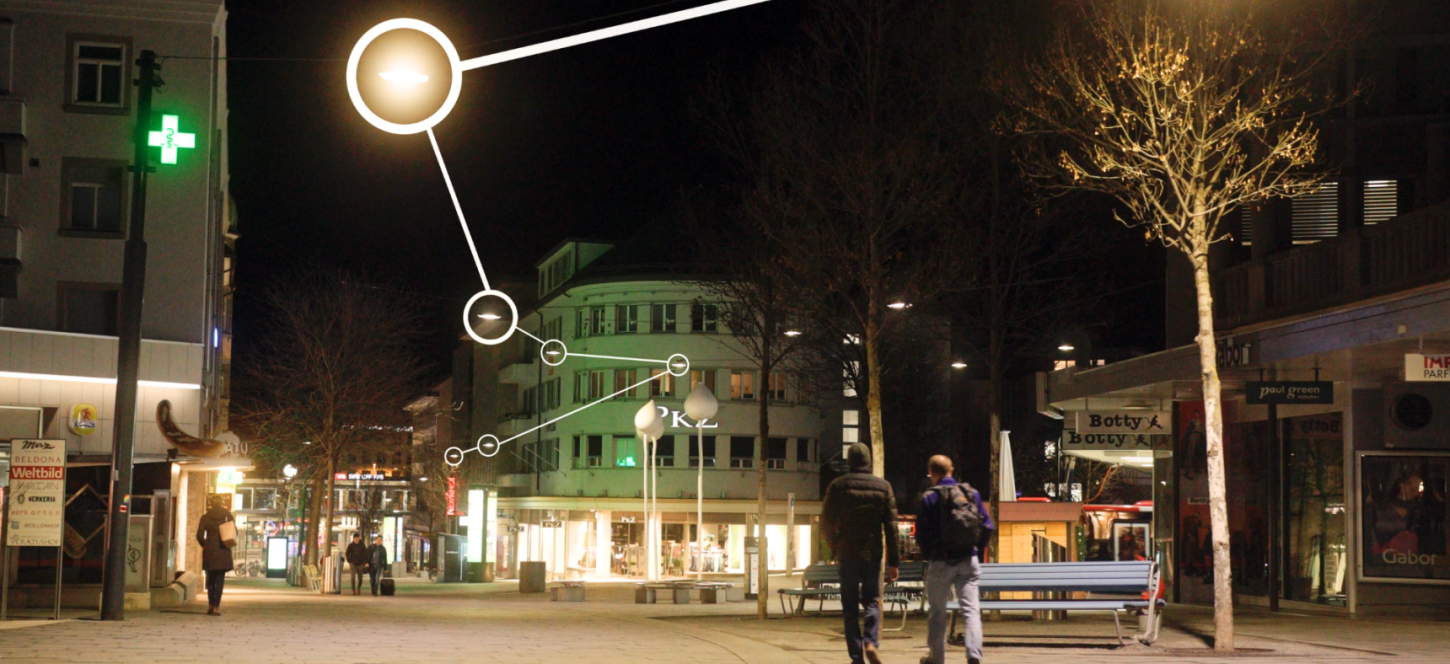
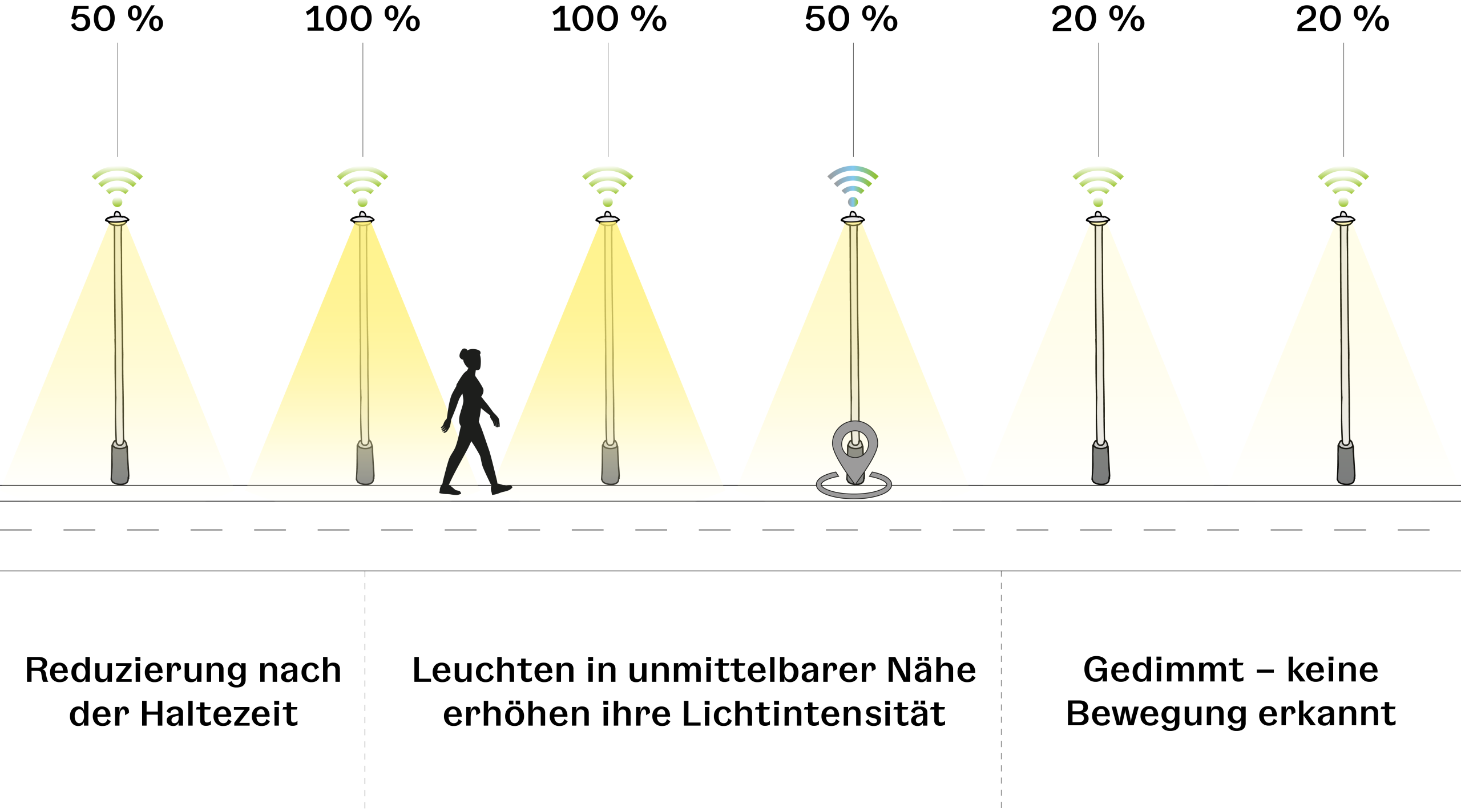
With dynamic lighting control, the lighting adapts in real time to the behavior of road users. Each light is equipped with a motion sensor. If a sensor detects activity in the detection area, the respective light dims to the specified brightness and transmits this information to neighboring lights. These also increase their light intensity to optimally illuminate the area.
After a defined holding period, all affected lights automatically return to a predefined base level. This results in dynamic adjustment of the lighting based on actual demand—exactly when and where it is needed. Light only when necessary, as much as necessary.
- Motion detection: Lights around the motion increase their dimming level (e.g., 100%).
- 60 sec. hold time: 60 seconds after no movement is detected, the light intensity is reduced to the base level.
The lights immediately dim to the specified brightness as soon as movement is detected in the detection area. After a specified period of time without further movement, the lights return to the base level to save energy.
Technical requirements for running lights
The lights must be equipped with a motion sensor, which is usually based on passive infrared (PIR) technology. This technology detects movements of objects that have a temperature difference of at least 4 °C from their surroundings. In addition, radar technology can be used, which is particularly reliable for slow and fast movements and also works in difficult weather conditions.
- Our SLC-Motion203, Lix.Pure, or Lix.One are used for luminaires with a Zhaga interface.
- Luminaires without a Zhaga interface can alternatively be retrofitted with our SLC-Box Motion or SLC-Box Radar mast box.
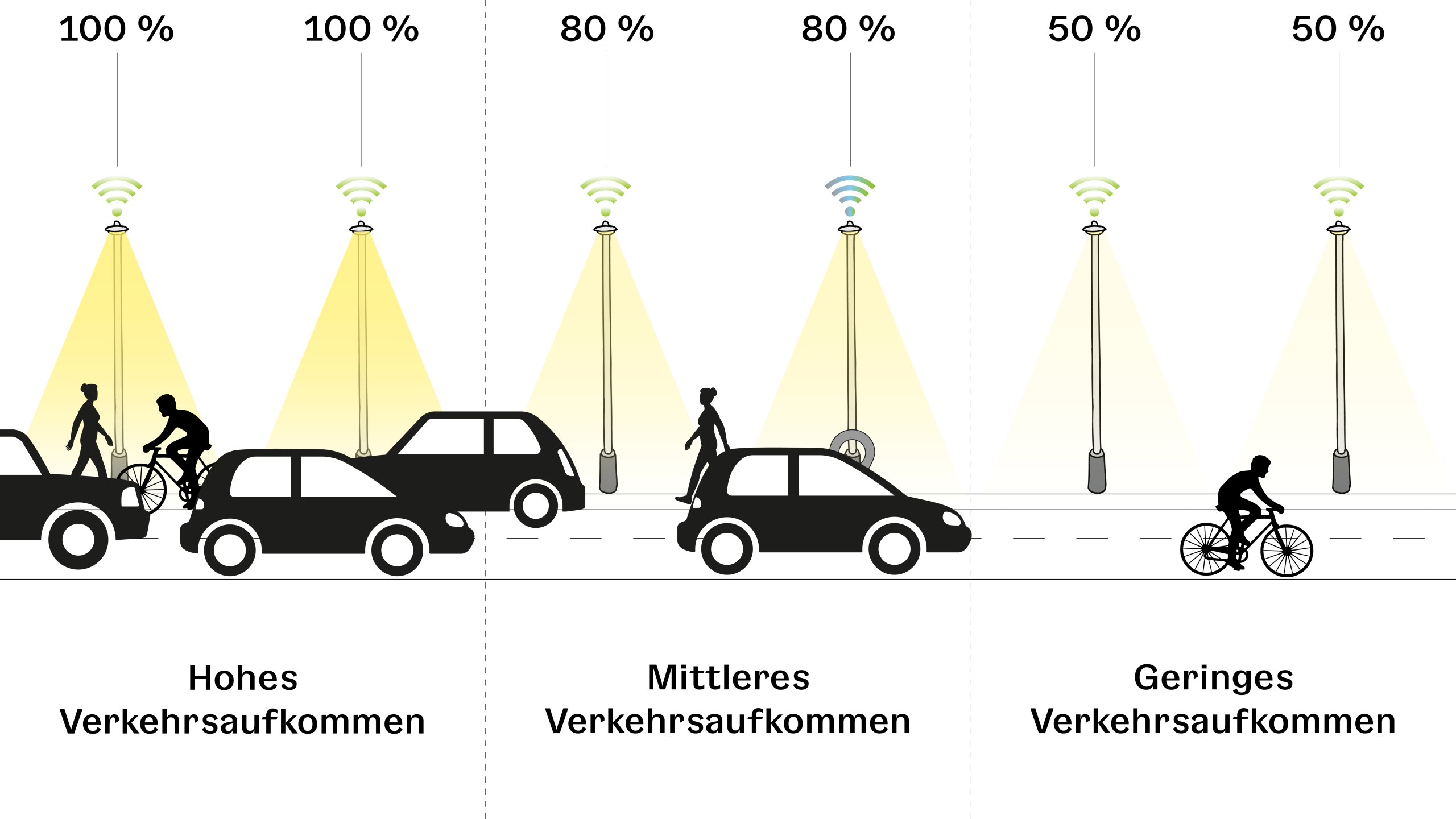
With volume-based lighting control, the brightness of the lighting is adjusted to the actual traffic density. Control is via motion sensors that detect how many vehicles, bicycles, or people are moving on the road within a certain period of time.
The higher the traffic volume, the brighter the lighting – when traffic is low, the light intensity is automatically reduced. This creates efficient, demand-based lighting that saves energy and reduces light emissions.
- For less than 500 road users per hour = 50% light intensity
- Between 500 and 1000 road users per hour = 80% light intensity
- With more than 1,000 road users per hour = 100% light intensity
The thresholds and dimming levels can be freely configured—for example, for heavily frequented areas such as traffic routes around event halls, train stations, or sports stadiums.
Technical requirements for volume-based lighting control
For this control system, the lights must be equipped with motion sensors.
- Our SLC-Motion203, Lix.Pure, or Lix.One are used for luminaires with a Zhaga interface.
- Luminaires without a Zhaga interface can alternatively be retrofitted with our SLC-Box Motion or SLC-Box Radar mast box.
A particular advantage of the SLC-Box Radar is that it also enables road users to be classified—for example, to distinguish between pedestrians, bicycles, and vehicles.
Downloads
Laden Sie aktuelle Datenblätter, Kataloge und technische Dokumentationen zu den esave Lösungen für intelligente Strassenbeleuchtung herunter.
Die folgenden Datenblätter werden in Kürze aktualisiert.
SLC-Enviro203-C – Datenblatt (EN)
SLC-Noise203-C – Datenblatt (EN)
SLC-Noise203-C – Datenblatt (DE)
SLC-Switch One – Datenblatt (EN)
SL-Controller AC/DC – Datenblatt (EN)
SLC-Box Repeater – Datenblatt (EN)
SLC-Box Radar – Datenblatt (EN)
SLC-Box Motion – Datenblatt (EN)
Reparatur & Rücksendung (RMA)
Damit wir Ihre Rücksendung schnell und effizient bearbeiten können, bitten wir Sie, für alle Rücksendungen (Reparatur, Umtausch oder Gutschrift) unser RMA-Verfahren (Return Material Authorization) zu verwenden.